Loading...
Loading...
Hi, my name is Marco. Working as a Senior Software Architect at Philips. I'm an Open Source Maintainer and Contributor.
If you like my work, consider to sponsor my work.
I wrote my first blog March 2011. Mostly I'm writing on software development. In total I wrote 75 articles in 8 categories. Use search below to filter by title or click a category or tag to filter by category or tag.
Hi, my name is Marco. Working as a Senior Software Architect at Philips. I'm an Open Source Maintainer and Contributor.
If you like my work, consider to sponsor my work.
I wrote my first blog March 2011. Mostly I'm writing on software development. In total I wrote 75 articles in 8 categories. Use search below to filter by title or click a category or tag to filter by category or tag.
Marco Franssen
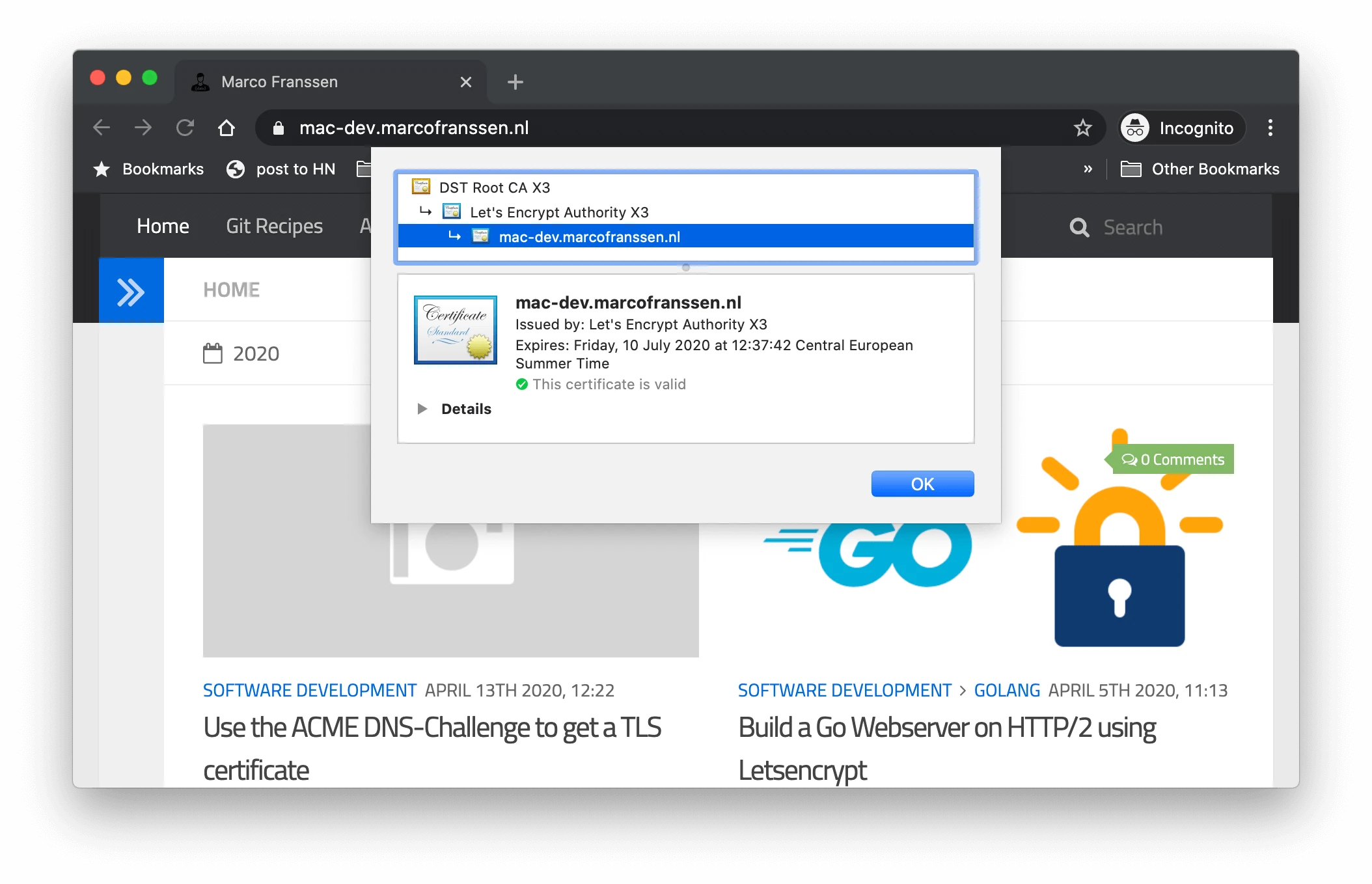
In my previous 2 blogs I have shown you how to build a HTTP/2 webserver. In these blogs we have covered self signed TLS certificates as well retrieving a Certificate via Letsencrypt. I mentioned there you will have to expose your server publicly on the internet. However I now figured out there is another way. So please continue reading. Let's Encrypt is a free, automated, and open certificate authority brought to you by the nonprofit Internet Security Research Group (ISRG). Letsencrypt impleme…
Marco Franssen
Pretty often I see developers struggle with setting up a webserver running on https. Now some might argue, why to run a webserver on https during development? The reason for that is simple. If you would like to benefit from HTTP/2 features like server push, utilizing the http.Pusher interface, you will need to run your webserver on HTTP/2. That is the only way how you can very early on in the development process test this. In this blog I'm showing you how to do that in Go using Letsencrypt and a…